Showing posts with label diaspora. Show all posts

Wednesday, October 17, 2012

Fritz Kreisler and my Red Wool Scarf

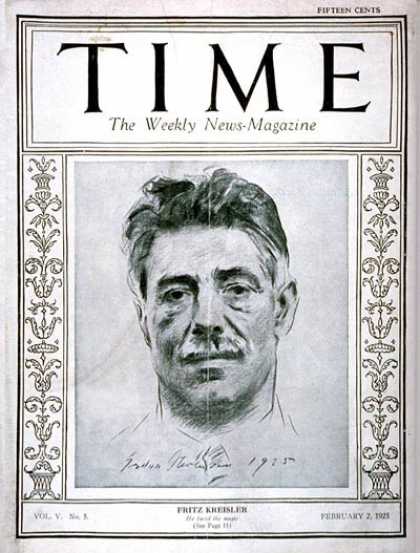
Fritz Kreisler - Time Magazine - February 2, 1928


A keepsake from my late aunt came to light in cleaning out an old closet today. Alas the old Christian Dior winter coat (from my long gone glory days in banking, bought at Barney's NY with part of a real Christmas bonus) had succumbed to moth holes and is a loss but there in the pocket was tucked away an old plain red wool scarf – no holes thank God.

My aunt had been an employee to the late Mrs. Fritz Kreisler as cook, part-time housekeeper and companion in the Kreisler New York apartment.

After Fritz Kreisler died, Aunt Mary brought us a bag of some men’s toiletries, cologne bottle wrapped in a cork label (la dee da) etc. and this old red scarf that Mrs. Kreisler said that my aunt could dispose of, and that the violin virtuoso had once used in life. I guess I took the scarf out of that bag of hand me downs and it has somehow stuck to me through the years.

Today I found it again.  Today I finally looked up Kreisler’s bio on Wikipedia for the first time.  I have memories of the fact that my parent’s generation took for granted live radio performances of this violin player in the golden days of radio.  His name was a household item in the day of live connected human entertainment. 

No canned music on the media back then. Some thought the idea of playing a record of a virtuoso in live prime time radio as something obscene. There is a remark to that effect somewhere in the movie “The King’s Speech” whereby the establishment thought a recorded voice of the King giving a canned speech would somehow be considered fraudulent. Well, the times do change. Whatever.

It is no wonder why Hitler and his vision of the future failed. With a diaspora of Jews like Einstein and Freud and not pure Aryan Christianized artists like Kreisler, it reminds me of the present already failed vision of the German pope who now wants to caste out all intellectuals, feminists and gays from the RC church in the next to fail European vision thingy. Oh well.  

Enjoy the art.  Forget the politics.


Wednesday, May 4, 2011

When were the Gospels written / 120 -140 A.D./C.E. ?


Following my own timeline thing and in my personal quest of a better truth of the founding and evolution of the Christian faith, I am saying, I am believing that the four Gospels were assembled somewhere between 120 and 140 A.D. of the common western era.

I say this in my own Jesus seminar styled search. I say assembled above which a little is bit different than written. I believe that the sayings of Jesus in a Gospel of Thomas like format got expanded into metaphoric descriptive fashion.

As in Jesus, if he said this, he probably said it to a crowd and or to a select few. The elusive “Q” document of nineteenth century Christian scholarly fame was no doubt a bunch of quotes on the back of a lot of envelopes from possible eyewitnesses to the event of that great moral teacher’s life.


Of course they did not have envelopes back then but I think you get the idea and image from what I just said.


The other thing that makes me think that the three synoptic gospels were written between 120 and 140 A.D/C.E. is the fact that Jesus is still Jewish in them. He is folksy and short in speaking style.


Going back to my own blog

Trajan’s demonization of the Jews

and the Kitos genocidal Roman war against the Jews and Semites of North Africa and the Middle East, I see the dividing line between the Jews and Christians in real form if not in written form about this time.


In fact while reading about that holocaust, that it started in Cyrene, present day Libya, North Africa, I went on to see that the first three Gospels mention a Simon of Cyrene, a tourist and or refugee of sorts in Jerusalem on the first Good Friday.

To refresh your memory here are those Simon of Cyrene quotes from the first still Jewish Christian gospels.


“And they compelled a passer-by, Simon of Cyrene who was coming in from the country, the father of Alexander and Rufus, to carry his cross.” (Mark 15:2).


“And as they led him away, they seized one Simon of Cyrene, who was coming in from the country, and laid on him the cross to carry behind Jesus.” (Luke 23:26).


“As they went out, they came upon a man of Cyrene, Simon by name; this man they compelled to carry his cross.” (Matthew 27:32).
Researching the Internet for this common thread/reference to Simon of Cyrene led me to this interesting article and quotation.
 
Gospel Mysteries – Gospel of John
Similarly, many of the stories found in the other gospels, but not in John, probably came from sources known only to their authors. Thus, the use of different sources can easily account for many of the differences between John and the other gospels.


But that explanation doesn't work very well for some differences, especially the difference in how Jesus is depicted. The first three gospels portray him as a teacher, healer, and prophet whose main concerns are the problems of society and the need for people to live more virtuously. In these gospels he shows great compassion for poor, oppressed, and outcast people, and he heals many disabled and demon-possessed individuals. When he teaches, he talks in simple language, draws images from everyday life, and uses parables to make his points.


But the gospel of John depicts him quite differently. In this gospel he talks in a different style, and often uses words and ideas not found in the other gospels. Instead of making short penetrating statements about how people should live, he gives long speeches about why he came to earth and why people must accept him as their savior. He rarely uses parables, and he doesn't cure any cases of demonic possession.
Putting the above quote aside for a few moments, I had already decided that this reference to Simon of Cyrene in the three gospels had some real significance and was possibly in fact a little bit of propaganda and or proselytizing of early Christians toward the surviving Jews of the Kitos War 115-117 C.E..


That is, you have an executed Jesus, you have a crucified Jesus, why not build on it as a recruiting tool to many Jews who survived the recent genocide and show empathy in the way of death. No doubt there were thousands of Jews crucified along the Roman roads that connected North Africa to Jerusalem and onto Syria and Turkey (Asia Minor) after the Kitos War.


Now getting back to the recent quote above, the whole article was quite interesting. From that article I get the sense that the original three gospels are written in a Jesus is a common man mode with simple parables and messages. That the original Christians were survivors of the Great Jewish Revolt 66-70 C.E. and living in rural areas all over the Middle East.


That the reference of Simon of Cyrene sharing a cross with Jesus occurs in Mark and is copied into Matthew and Luke. By this I see that Simon of Cyrene was not haphazardly added to already written gospels but was part of original text. As such, I speculate that the first three synoptic gospels are assembled/written in post 117 A.D. after the Kitos War.


That the scattered communities across the middle east and in perhaps Rome as well were living off legend, oral tradition and the Letters of Paul and were coming together, in a still recruiting from the original Jewish cult thing, and turning into a new sect different than the original Judaism.


In fact I think that the historian Suetonius’ quote of fellow historian Tacitus in the persecution specifically of “Chrestiani” is a retroactive cut and paste job of history. That after the Kitos War, the more sophisticated Jewish Christians in Rome were doing a sudden Public Relations blitz and press release thing to say that their history as Christians (sans the Jewish in Jewish Christian thing) went back many decades before the recent unpleasantness in the African and Middle East provinces.


That to say you were persecuted by a hated dictator like Nero was a positive and not a negative in the early propaganda of the church. That and you were retroactively and consciously separating yourselves from the traditional Judaism thing.


In a way, while a rural populist thing is going on outside of Rome, the urbane, sophisticated Roman Christians came up with an Urban Gospel in the form of John. That these changes within the same movement occurred simultaneously or close to it.


In fact, I see the rural country bumpkin preacher of Jesus transformed into this polished Gnostic like god (small g) in the Gospel of John. The Gospel of John I see as the urban guide to the new Christian cult for the largely Gentile only city dwellers from the Mid East, through Greece and into Rome. This, especially after the final Jewish war by Hadrian 132-135 blew all Jews into definitive and seemingly eternal Diaspora.


I find it incredible that I cannot find much on the last two of these three Jewish wars, that they don’t get much mention on the Internet. It is possible that Jewish scholars have not yet put history from books onto the Net. It is also possible that Judaism prefers to forget the whole matter. That the only much quoted writings of the history of the Jews is from Jewish/Roman writer Josephus Flavius and centering on the destruction of Herod’s greatly altered/remodeled Second Temple is enough to address that period in religious/political history.


In any case, my studies and research continue. I hope in the very least that this crazy theory of mine makes some sense and will in time make more sense as bloated, vested Christian theologians die off and the true spirit of Jesus in the early real Christian church evolves back to not a local pagan level but to a truly first and global belief system.


Saturday, April 16, 2011

All religion is politics. All religion is local.


Judaism, Christianity, Islam are not religions so much as political parties. Their founders - Moses, Constantine and Mohammed were all generals.  Politics and war came first in the founding of these ideologies.


If an outer space alien could communicate with me in English, a language I am a master of, and ask the 64 trillion dollar question about what is all this religious strife on planet Earth about, well here goes.


Do Jews, Christians and Muslims worship the same abstract idol and or God? NO!


Definitely not!


A Muslim’s mother’s beef stew is not the same as a Christian’s mother’s beef stew.  


Only momma knew how to cook beef stew. 


For you to compare my mother’s beef stew to your mother’s beef stew is an insult to my mother and to me. 


And there you have modern religion; same as ancient religion.


All religion is local – just like politics.  All belief in God is local as well.


That’s the point with ancient paganism when it went up against the corrupted form of Judaism aka as Christianity.  They were going up against the abstract of One God in One Temple in Jerusalem.  There were no annex temples in the ancient holy land.  God had no vacation homes.


The Jews had one God and he along with his consort Asherah were worshipped in the great temple of Solomon until the Babylonian captivity. 


When the Jews did come back from Babylon, along with their Babylonian concubines, they rebuilt the mud hut, the great temple of Solomon.  They discarded Asherah.  The feminine side of their god disappeared.  God evolved, he then had a male side only.  Christianity is based on Judaism and Islam is framed on these two previous male only gods/politick/religions.  


Of course the Jewish god only talks Hebrew.  The Christian god only talks Aramaic, Greek and Latin.  And the Muslim god only understands Arabic.  One idea.  Three different gods.  E Pluribus Unum?  Hardly.


So when the Roman Nazis come along and could not impose Roman politics onto Jerusalem, they destroyed the Temple.  The genie was out of the bottle.  Because once you remove the geography of the abstract Jewish god, anybody including the Christians or the Muslims can add on their mom’s recipe for beef stew to the traveling ghost of a concept of one God in that god’s diaspora.


Yahweh was destroyed in 70 A.D./C.E..  All the kings horses and all the kings men could not put Yahweh back together again or at least serve the same beef stew ever again.


While the Jews, as the object of their inspirations and prayers, point back to a temple god of two thousand years ago, the Christians point back to general Constantine’s mom’s beef stew recipe, the Nicenian  heresy, and the Muslims look to the Kaaba.
 
Hinduism, which absorbed all local gods as it evolved as a political entity, let the local deities stand and evolve too along side the poltical “religion” etc..  Ironically, here is a quote from what appears to be a polytheistic culture about the weird unrealistic concept of a one god – a one size fits all deity.  


Why are there so many Gods in Hinduism?

God is one. There is only one Real and True God who does not have any form or a name. It can neither be described, thought of or conceived through human faculties. But since we are so many, each one of us conceives God according to our attitude, view points and state of life -- just as a woman can be looked upon differently by different people: mother, by her children; wife, by her husband; sister, by her sisters; daughter, by her parents; granddaughter, by her grandparents; sister-in-law, by her husband's brother, etc. The woman is one and the same, but she is viewed differently by each one of her relatives. Similarly, we look upon the same God in many ways.

I believe most Hindu’s are vegetarians.  I therefore probably cannot compare their politics/religion with my mom’s one true authentic recipe for beef stew.
 
Whatever. 

In most ancient cultures, the heart was the center of intellect and intuition.  In their hearts, Jews, Christians and Muslims perhaps understand and commune with the same God. But using a scientific metaphor – language, words, geography  – in other words, a form of gravity is introduced into the equation  – which confuses the perfection of the human heart with the questions and imperfections of the human brain with its tags and labels.

If man is both part beast and part angel, the question of - do Muslims and Christians worship the same God? – who is asking the question - why - and in what force of gravity present?