Showing posts with label Columbia University. Show all posts

Friday, September 21, 2012

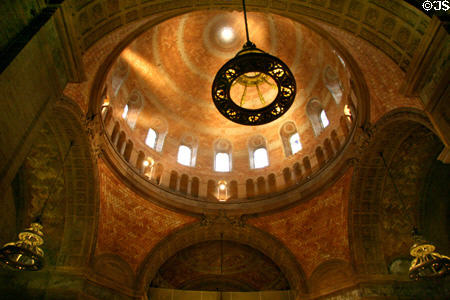
Vortex - St. Paul’s Chapel Columbia University - NYC


One of the unusual architectural gems of New York City is Saint Paul’s Chapel on the urban campus of Columbia University, 116 Street and Broadway. This chapel not to be mistaken with the pre-revolutionary St. Paul’s Chapel and graveyard on Broadway downtown across from the World Trade Center.


Unexpected to some is the optical illusion one must get used to, of stepping into what appears to be a small church building and then finding oneself within the surprising cathedral like space inside. A spiritual Vortex?


*   *   *

Thursday, August 5, 2010

Cordoba House - WTC - Columbia College - NYC

College and University is a place to broaden one’s knowledge of the diversity of the world in all its aspects.

Some American universities such as Harvard started out as places to study theology. While a degree in Theology at Harvard is a noteworthy thing, it does not say much about the individual that holds the degree.

Life is about Experience. The experience many had on 911 at the World Trade Center effected all of American culture including its thinking. While the theme behind 911 was anti-American, it was also anti- western Christian Culture. 911 began as a domestic American day. It ended as a day of global reflection.

The Cordoba House/Mosque complex in New York City to be built in an office tower structure of 13-15 stories sits exactly on part of the foundation stones of part of the original King’s College building – later to become Columbia University uptown. Literally, this is true.

It is rather fitting that a place, a Muslim culture place, be part of the world and or global culture and that it is to sit on a place dedicated to learning that goes back almost two hundred and fifty years. The beginnings of a Global Culture, of a new human race, I believe starts at the New World Trade Center rising from the ashes of the old.

So like the secular colleges of today, the Cordoba House/Mosque center will be a place of learning and broadening outlooks from the very narrow focus that began the day of 911. The end of that day sent us looking for many answers.

Sometimes the answers are right there in our midst. A mosque in downtown NYC is as natural as the wind as a place to be. And a place for cultural growth.

Tolerance. Learning. Diversity. Just a few global words to throw out there today.

Saturday, June 12, 2010

Cordoba House - NYC - Mosque - Columbia College


Recalling memory of perhaps forty years past, I have to say one of the best basic cookbooks of all times on basic American cooking is the Settlement Cook Book. It’s recipes are derived from a cultural secular phenomenon called Settlement Houses that existed in the heyday of mass immigration into American culture in the late 19th and early 20th centuries.

Reading the various things being put out there, I go back to the concept of Cordoba House as a community center. I am reminded of the settlement movement, a secular movement in the 19th century both in England and the United States.

Having done some research on Islam, the Mosque as the center of a community is more secular a building than the west would treat a church as sacred. A church might have a community center but rarely do you see children in churches doing homework or reading, memorizing the bible.

The Mosque as community center and as planned in Cordoba House sounds more like an old-fashioned settlement house where someone like Eleanor Roosevelt did her Christian charity and taught some classes to the poor in a secular settlement house in the slums of NYC.

As the name suggests, in the American model, a settlement house that taught English, civics, hygiene, cooking and provided a gymnasium in the midst of crowded tenements, it, as a community center was also like an assimilation center for immigrants to ease into the American culture.

Cordoba house, especially for a fundamentalist or a Sufi specialty branch of study is perhaps a settlement house of sorts. The difference is that Islam is the center of community, secular like, structure?

Settlement houses went out of existence with the social safety net of government established and expanded over the decades. I have often thought that as in the case of influx of Mexican immigrants, legal and illegal, that an old-fashioned concept of a settlement house teaching English and American customs might be an old idea that would ease some tensions between the existing culture and the influx of a foreign culture(s).

There is now some credible evidence surfacing that the Proposed so-called World Trade Center mosque, Cordoba House will sit on approximately forty percent of the original land that was under the original Columbia College Building, now Columbia University, when it started in colonial times on what is now the street called Park Place in downtown Manhattan.

Columbia College Building 1857

Cordoba House being proposed on this historic American spot is perhaps a good marriage of the old native culture blending into the new secular global cultural still forming.

Friday, January 29, 2010

Cathedral Spaces - St. John Divine NYC


In walking distance, it is maybe eight or nine blocks from the extreme northern end of Central Park. It is the crown on top of the so-called fashionable upper west end of Manhattan. It is the southern boundary of the Columbia University campus. I am of course talking about the Cathedral Church of Saint John the Divine - 112th Street and Amsterdam Avenue, New York City.

All sorts of adjectives and descriptions for this unfinished mish mash of styles, Romanesque and Gothic. The Nave is 600 feet long, the size of two American football fields laid end to end. It is second only in size to St. Peter’s in Rome. I am not certain where that big church in the Ivory Coast fits in, in terms of size, volumes etc.

This perhaps quiet, unforgotten gem of New York City architecture has been in building mode in spurts and stops since 1892. Many say that this seat of the Episcopal Bishop of New York is a dodo bird of sorts. It defies description but its internal space is why I am writing about it. One brief building period in the middle eighties to middle ninties added fifty feet (one third) of the Southwest bell tower in first photo above. It will not be finished in my lifetime.

I first encountered this behemoth structure in the middle of an May rain storm over thirty years ago. Getting out of the rain was indeed a pleasure but I have not stepped into any other such a magnificent space since. I have been in Notre Dame in Paris and only have a vague memory of it except that I thought it rather plain for all the hype. The average tourist never makes it here unless on a tour bus or religious bus tour package. It is as hidden a treasure to native New Yorkers as it is to the accidental tourist who, like me, literally stumbles upon its sheer space and audacity of being.

I have not been there since the fire and the smoke damage that required extensive and expensive cleanup. Less smoke damage would have occured if they has broken the stained glass to vent the fire. The officials at the Cathedral asked the fire marshall not to touch the windows which led to seven years of clean up that now has put the building on par with anything of Medieval European religious gothic architecture in official tourist guide books.

My first impression there had to do with that of the sheer size. The darkness of its soot covered interior walls was a result of having been submitted to fifty years of old New York City coal burning for heat and cooking in the air and reaching inside an open and unfinished church.

That dark space I feel to this day and a sense of what an astronaut must feel floating in outerspace, as I looked up into a seeming infinite darkness. When they finally opened the church in 1941, they put a temporary plywood dome over the unfinished transept expecting to finish the work after WWII. Funny how that temporary roof painted black made for such magic inside with a few electric lights, votive candles and gloomy exterior rain filled light making a faint register through blue colbalt colored stained glass.

Now over a hundred years of coal soot and fire smoke damage and general grime are cleaned up. The building was rededicated in late 2008.

The cathedral, not so crowded as with the huge number of midtown tourists that frequent the likes of St. Patrick's, makes this place a very quiet and meditative sort of place.

There is plenty of artwork, tapestries, icons, statues and it has a Holocaust memorial sculpture. It is an all purpose building that fits into the secular needs of the nearby Columbia University community. It is host to concerts, plays and even the annual blessings for animals small and big as elephants if need be.

It is a place where famous people, well loved people, have their post mortal memorials because of the thousands of people who can crowd into the space. I recall the author James Baldwin's memorial service took place there. It seemed appropriate since the rear of the cathedral sits on a slight hill and overlooks most of Harlem.

A very interesting place.

Here is a dated review of the place from the Ship of Fools website that reviews services and architecture of houses of worship worldwide.

1164: Cathedral of St John the Divine, New York City

And of course the annual Francis of Assisi Animal blessing.


I close in quote from the first video above.
"It moves me intellectually, emotionally, spiritually. It illustrates what architecture can do to the human animal. What an expression that architecture can be to the human spirit” --Alfred Blanco, Cathedral docent

Highlights of a Cathedral’s Rehabilitation
-