Friday, May 16, 2014

Old Saint Michael’s Church NYC – 1857 / 1907 - NW Corner 9th Avenue, 31st to 32nd Streets – Eminent Domain – Old Pennsylvania Station – and Tunnels


Old St. Michael's Church and School - 1868
NW Corner Ninth Ave and 31st-32nd Streets
(Public Domain)
Image: http://library.gc.cuny.edu/34th_st/items/show/880


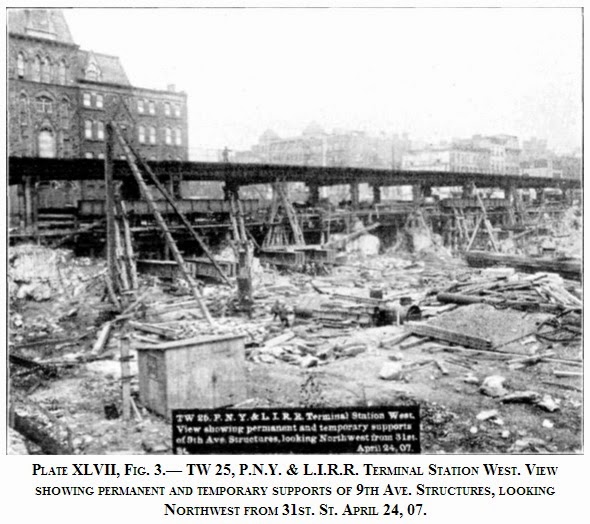
Location of Work.—The area covered by the work of the Terminal Station-West is bounded as follows: By the east line of Ninth Avenue; by the south side of 31st Street to a point about 200 ft. west of Ninth Avenue; by a line running parallel to Ninth Avenue and about 200 ft. therefrom, from the south side of 31st Street to the boundary line between the 31st and 32d Street properties; by this line to the east line of Tenth Avenue; by the east line of Tenth Avenue to the boundary line between the 32d and 33d Street properties; by this line to the east line of Ninth Avenue. The area is approximately 6.3 acres.
House-Wrecking.The property between Ninth and Tenth Avenues was covered with buildings, 94 in number, used as dwelling and apartment houses and church properties, and it was necessary to remove these before starting the construction. Most of the property was bought outright by the Railroad Company, but in some cases condemnation proceedings had to be instituted in order to acquire possession. In the case of the property of the Church of St. Michael, fronting on Ninth Avenue, 31st and 32d Streets, the Railroad Company agreed to purchase a plot of land on the south side of 34th Street, west of Ninth Avenue, and to erect thereon a church, rectory, convent, and school, to the satisfaction of the Church of St. Michael, to hand over these buildings in a completed condition, and to pay the cost of moving from the old to the new buildings, before the old properties would be turned over to the Railroad Company.

(Old St. Michael's School - Top Left)

The house-wrecking was done by well-known companies under contract with the Railroad Company. These companies took down the buildings and removed all the materials as far as to the level of the adjacent sidewalks. The building materials became the property of the contractors, who usually paid the Railroad Company for the privilege of doing the house-wrecking. The work was done between April and August, 1906, but the buildings of the Church of St. Michael were torn down between June and August, 1907.
The bricks were cleaned and sold directly from the site, as were practically all the fixtures in the buildings. The stone fronts were broken up and left on the premises. Some of the beams were sold on the premises, but most of them were sent to the storage yards. Some of the lath and smaller timber was sold for firewood, but most of it was given away or burned on the premises.


St. Michael's Church 424 W. 34th Street NYC
(School Building on 33rd Street)
(Photo: 
Jeanette O'Keefe,


.

Thursday, May 15, 2014

Souvenir - World Trade Center – Dish 6 ¼” Diameter – Tall Ships Bar – Vista Hotel – February 1983


6-1/4" Plate - Tall Ships Bar - Vista Hotel - World Trade Center NYC - 1983


I see that the WTC "911" museum is about to open at the New World Trade Center.

Admission charge $25.00 (Freedom ain’t free folks.)

Burgers, Fries and Cokes available in the Visitors Gift Shop and Food Court???


I have my own memories and a piece of the old Tall Ships Bar of the Vista Hotel, part of Hilton (later a Marriott on 9-11-2001).

Memories of drinks with friends. Not memories of chaos and death. 

Watched them build the hotel piece by piece from across the street at Bankers Trust Plaza 130 Liberty Street when I worked there. 


Source: New York Magazine  28 Nov 1983 - page 145

Wednesday, May 14, 2014

“Millionaire’s Prayer” – To the Money god – Father Thomas J. Ducey – St. Leo’s Church NYC - 1901


Image Source: King’s Notable New Yorkers 1896-1899
 (original copyright expired)


Rev. Ducey, a noted New York priest and socialist, is the author of the following “Millionaire's Prayer” to the gold god - a paraphrase on the prayer which Jesus taught his disciples:


“My father who art in heaven; 
hallowed be thy name.

My kingdom has come on earth;
thy will be done - in heaven; 
my will be done here.

Give me this day all the income I want.


 Give me my debts in violence against humanity, 
in foreclosure against my debtors.

Deliver us this day from all the ‘isms’ 
that destroy our power
 to enslave humanity.

Mine is the kingdom and the power, 
and thine be the glory forever.

Amen!”


.

A Mounted Police Officer on Duty - Union Square NYC - 1905


Copyright, 1905, by Harper & Brothers. 
From “Harper’s Weekly”.
(original copyright expired)

A Mounted Police Officer on Duty at Fourteenth Street and Fourth Avenue.


(original copyright expired)


.

Tuesday, May 13, 2014

Dinner at Delmonico’s 26th Street and Fifth Avenue – “Tony Pastor” Father Thomas Ducey of St. Leo’s New York


Delmonico's Restaurant - SW Corner Fifth Avenue at 26th Street NYC (1876-1899)
(Public Domain - United States)


...How a man made his money was no concern of “Del's”; he was welcome so long as his behavior was correct and the “solid” element raised no objection.  Hummel was well-mannered; and even the stalwarts of the Tenderloin police, unchoosey as to the sources of the incomes that were much larger than their salaries, took their ease in off hours with the dudes and the dandies, the Cuban patriots and prima donnas, the lovely women and lonely old maids who nightly gathered there. Nor was the unction of religion withheld from the well-fed throng.

A patron of imperishable benignity was the Reverend Thomas J. Ducey. In addition to fulfilling parish duties, Father Ducey occuped the position of virtual domestic chaplain to the Delmonico family.  His mother had been housekeeper for James T. Brady, the celebrated forensic orator of the mid-century whose name had been all but synonymous with the Chambers Street Delmonico's. This early association had given Ducey a tenuous connection with the world of wealth and as a priest he had devoted himself to the spiritual welfare of that class. Men and women plentifully blessed with the goods of this earth are surely entitled to the consolations of religion as much as the poor; indeed, if Holy Writ be trustworthy they may need those consolations more.  To them Father Ducey extended the blessings of church and ceremonial in the style to which they were accustomed.

In 1880 Father Ducey was enabled to build his own church - St. Leo's in East Twenty-eighth Street - mainly with the assistance of two intimate friends Lorenzo and Charles Delmonico.  St. Leo's was a small church and select; the congregation was drawn from the well-to-do who lived in the neighborhood. Father Ducey like a London monsignor of the same period was sometimes lightly termed the “apostle to the genteel”, yet he was as compatible with the poorest suppliant as with the proudest millionaire. He solicited the welfare of his flock on weekdays as well as Sundays dined where they dined (at Delmonico's) and was a constant reminder of their hopes of heaven in the banquet hall as in the sacristy. The dinner banquet hall sacristy hour was his vespers, and it was said that the text Father Ducey elucidated with the profoundest penetration came from the Gospel according to St. Matthew chapter 11, verse 19: “The Son of man came eating and drinking.”

At times the diocesan authorities wondered about Father Ducey; he was considered erratic; they certainly looked askance at some of the jokes the good Ducey was inspiring. Example: “Why is St Leo's like a certain theater on Fourteenth Street? Answer: “Because it has a tony pastor.”(*)

Father Ducey pursued what is known as “the even tenor of his ways”- even while winding his way back to the rectory from Delmonico's - and might have winningly invoked the sanction of the concluding sentence of the above-cited Scriptural verse: “But wisdom is justified of her children.”


(*) Tony Pastor 


.

Artist Studios – aka Y.M.C.A. Building 1869-1903 – 52 E 23rd Street – 23rd Street and Fourth (Park S.) Ave – James Renwick Jr. Architect


Y.M.C.A. - 52 East 23rd Street - 23rd Street and Fourth Avenue NYC
James Renwick Jr. - Architect
(public domain)


The first built for the YMCA purpose building in the United States in New York City, the “Christian Clubhouse”, was located at east 23rd Street, SE corner, and then Fourth (Park) Ave and finished in 1869.

Built across from the National Academy of Design on the NW Corner of 23rd Street and present day Park Avenue South, the YMCA building had 40 artist studios for rent on the top two floors, 4th and 5th floors.  Rent from the studios subsidized the mission of the "Y" as a Christian clubhouse with Library, Reading Room, lounges, classrooms, lecture rooms, large Auditorium and Gymnasium in the basement. Also some store fronts for rent on the NE corner frontage.

That along the timeline some of the artists who rented space at "52 E. 23rd Street" NYC were:


Alexander Helwig Wyant (who also died there in his studio)


Recommended Reading:


.

Monday, May 12, 2014

Catholic Church In Boston Afraid of Religious, Political and Cultural Diversity – Black Mass Tonight at Harvard To Celebrate Free Will and Human Nature


The Archdiocese of Boston, the Bernard Cardinal Law Bailiwick that recognizes and promotes child abuse by Catholic Clergy, and rewards people like Cardinal Law with big promotions in such cases, is now showing its total ape-shit drunken spirit-uality like Bill Donohue PR intolerance to the Satanic ritual going to be performed in a pub within the Harvard Campus area.

The problem with man-made mono-theistic religions is that they cannot flourish in diverse political cultures such as the United States. As such they, the Catholic PR machine fueled by millions of tax free donor dollars, is in motion to make the next guy uncomfortable in their shoes in the presence of their magic ancient not universal but non-universal provincial god. Beware.


If anything, like the made up Wicca practices of the nineteenth century to fill a gap of a dead cultural religious witchcraft of feminine cultures that the RC helped to ethnically cleanse from Europe centuries ago - the Black Mass of the Satanists is a reactionary ceremony to recreate the RC Mass with Priests with magic fingers making magic bread. This all in a kind of "Stockholm Syndrome" like grudging respect of victims to their former victim-izers. To worship what Satan truly represents - Free Will and or Human Nature. 

That without true spirituality within, all ceremonies or rituals are merely assembly lines in pie factories so to speak or at least from the this POV. Whatever.


.

Sunday, May 11, 2014

The Young Mother - 1881 - artist G.H.Story


The Young Mother (1881)
artist G.H.Story
Wadsworth Athenaeum Harford Conn.
(public domain)


The Young Mother, the 1881 version is in the Wadsworth Athenaeum Museum in Hartford Conn. The orginal version of The Young Mother, exhibited at the Philadelphia Centennial Exhibition 1876, for which the artist George Henry Story received a medal, the original version, whereabouts unknown. 

Happy Mother’s Day 2014


.

Rev. Father Thomas J. Ducey - St. Leo’s Church NYC - “Successful Americans” November 1900


Rev. Thomas J. Ducey
Photo by David H. Anderson (1827-1905), New York
(original copyright expired)


...During the last twenty years as Rector of St. Leo's Father Ducey has probably accomplished more for the “submerged tenth” than any other man of his resources in New York.  These philanthropic acts are not of common knowledge, however, for the reason that the kindly priest will never talk about them and if a visitor approaches such a topic the talk is diverted to literature, the arts, or sciences, or kindred generalities adapted to desultory conversation.

Perhaps the newspaper men realize more fully than any other class the extent of Father Ducey's generosity to the unfortunate.  It is within the writer's knowledge that during the last two years this notable priest has received more than twenty thousand applications for assistance many of which were from strangers in New York.  Of these over fifty per cent secured personal interviews and obtained material succor adapted to their several necessities while quite as many unquestionably undeserving were sent away.

It may truly be said that Father Ducey is the counsellor of the rich, the brother of the poor, and a father to humanity.  He believes in community of effort and resource.  The wealth and the woe of mankind excite him equally to establish more harmonious relations between labor and capital.  Only a few weeks ago he demonstrated the accuracy of this estimate of his character by visiting Hazelton, Penn., and the contiguous coal mining sections of that State in order that the American public might learn through the medium of his pen the exact differences existing between mine operators and their employees.  

Father Ducey has been active in nearly every movement inaugurated in New York designed to bring about municipal reform.  His independence of spirit has occasionally provoked the criticism of his ecclesiastical superiors but his views have always been so exalted and disinterested that censure could find no lodgment.

…Since his installation at St Leo's Father Ducey has watched his flock in that parish for a score of years.  Among his parishioners are many multi-millionaires. distinguished scientists. and notable leaders well as others in the various professions equally devout but lacking in acumen and substance as compared with more fortunate fellow worshipers.  A proportion of the church expense is from the priest's private means.  

A few years ago Father Ducey had his called to the need existing in all large cities for a place suitable for the reception of the "stranger dead" until relatives could arrive and inter the remains. Hotels are averse to sheltering corpses even of old time guests and they invariably refuse to receive a body for which temporary shelter is required.  Father Ducey determined to fill this need so far as New York was concerned.  The result is the only structure of its kind in the United States. It adjoins the church on Twenty-eighth Street, cost $75,000 and has been open for eleven months.  

In inaugurating this benevolent project Father Ducey expended several thousands from his own resources and the balance was subscribed solely by his non-Catholic friends. “I refrained from asking Catholics to contribute” said Father Ducey, “as I wished to be perfectly free so to incorporate the work that whoever succeeds me will be bound to carry out my purpose in the interest of the 'stranger dead' of any and all denominations.

And so it is that during the present year this unique structure has been the scene of fifteen funeral services which otherwise would have been performed in the back room of an undertaker's shop.

A.S.D.(author)

Sessa Nulma - David Arkenstone / Charlee Brooks from Loveren


Sessa Nulma, Sessa Nulma
Enchant tonight

Sessa Nulma, Sessa Nulma
Bring me to life
Spirit take me behind the sea to a universe that's ours

Sessa Nulma, Sessa Nulma
Treasure that I seek to find
Enchant me, sweetly, quietly, slow
Rivers flow out to the corners of the earth

Sessa Nulma, Sessa Nulma
Reflections in your eyes

Sessa Nulma, Sessa Nulma
Draw me close tonight
Guide me through all the sands of time
Through the darkness that binds me

Sessa Nulma, Sessa Nulma
Relentless desire
Cast your light on all that's true
Surrender your beauty
Let it be my muse

Sessa Nulma, Sessa Nulma
Enchant tonight

Sessa Nulma, Sessa Nulma

Bring me to love


.

Thursday, May 8, 2014

Confederate Veteran Michael Lyons - Mike Lyons Restaurant – 259-261 Bowery Finally Locks Its Doors – January 1907


I am thinking that “The Sun” reporter’s article below on the closing of Mike Lyon’s 24 hour restaurant has got more details in it than others including the NYT regarding the close of the one-time center of Tammany Hall lunch time and dinner time meals and political strategy sessions – those official and unofficial sessions being for the most part in the last decades of the nineteenth century.

The Sun reporter may or may not have been better connected to Tammany politics than others.

A few factors I am aware of probably put Lyon’s off the main track of good basic eats on the Bowery by January 1907.

Mainly, the entertainment center shifted up north to its present and seemingly final place around 42nd Street and Times Square. No more open real estate to following a shifting population in the once open spaces of the island. The Opera House, the “Academy of Music” kept up entertainment and vaudeville after the new 


Metropolitan Opera House opened in 1883 at 39th and Broadway – becoming the only main opera house in town – with the high brows going further uptown and staying up there for their champagne midnight suppers but not at Lyons’.


A lot of theaters started to migrate over the last two decades of the nineteenth century from around the east end of fourteenth street up Broadway and ending around the Longacre Square area, renamed later, and then the new New York Times building that was built as the centerpiece of this new “Times” Square wrapping itself around this anchor building on the southern end of that confluence of Seventh Avenue and Broadway at 42nd Street, that is btw not a square at all but more like the shape of a hour glass.


The news reporters hung around Lyons' of the old days to rub elbows with the Tammany men down from Tammany Hall on fourteenth in a building next to the old Academy of Music. The Tammany men were more likely to be in the vicinity of the old Police HQ at 300 Mulberry Street, about four blocks from Lyon’s.

Where better to hang out for politicians than at Police HQ in a very corrupt town. That all came to an end with the Lexow State Committee probe of NYC police corruption 1894-1895 and with reformer types like Police Commissioner Theodore Roosevelt at the same time who made good press on his appearance of making headway fighting the corruption of Tammany within the police force.


That and a new Police Headquarters to open in 1909 would push the cop lunch traffic another five blocks further south. In its day at Lyon’s, plain clothes cops and reporters along with tourists to the Bowery filled Lyon’s eatery twenty four hours a day.


With being an all-night restaurant is was not that inconvenient to grab a cab down from after the theater or opera on 14th street and pop a few corks of champagne at midnight or 2 A.M. etc.

The front door was never locked for something like thirty years until they started to close at midnight, in its last year or two in business. The subway further west near Broadway could carry what was left of the newspaper business and its reporters centered around City Hall downtown, next to the entrance to the Brooklyn Bridge - carry them uptown and faster than in streetcars and toward the new center of communication and NYC energy at Times Square. 

There was also the telephone as a new means of communication – no need to sit and talk person to person or over a fried veal chop to get details on deals at city hall.

At five A.M. the poor and housewives/mothers with baskets would line up at the front door in the Lyons’ “breadline” to get food scraps and day old bread not used by the restaurant. 

There was an enormous amount of charity to the neighborhood by Lyons in a world with little or no government social safety nets. It took from the local economy and it gave back some.

Economically sound too with little refuge to cart off guaranteeing that the food would always be fresh and wholesome unlike many other restaurants along the Bowery known for its cheap and dangerous leftover food delivered to the poor in this increasingly skid row like economic area.

Ironic I think that Confederate Private Michael Lyon’s of the Sixth Louisiana Regiment of Infantry company K would be handing out bread for the rest of his working life after being a baker of bread for the troops of the Confederacy – along the long road from New Orleans to Appomattox.

The Raines Law was an attempt to stop drinking of alcohol in public on Sundays in the late nineties. Sunday was the only free day of the week, the only day off for most working men. The stories of abuse and family breakup over drink was an early trial balloon by Republicans, for something like later Prohibition, to strike at the backbone of Democrats and their natural organization centered around saloons.
 
Only hotels could serve drinks and not from a bar but to a table in a hotel in New York City and only after a meal had been ordered – and yes a sandwich could now be considered a meal.

The loophole was that all you needed above your saloon was ten furnished rooms to qualify for a hotel license to protect the Sunday consumption of booze in your saloon business, now a hotel restaurant – the old bar area now crammed with tables.

Lyon’s already had a hotel license when the law went into effect.
Raines Law Hotels came into overnight existence and notoriety and they also came in two categories. The saloon actually rented out rooms or they just had ten rooms, not rented, as a sham to get a license.

The offset of protecting family values on the Bowery and other parts of New York City was that with so many new “hotel rooms” available, the Bowery became more heavily populated with prostitution, rent by the hour love nests for lunch hour and afternoon adulterous and single couples, and the poor who turned these SROs – Single Room Occupancies – into notorious flop houses.  The poor and the lawless, feeding and growing off the fruits of good intentions of government trying to impose blue laws on the population etc. (sarcasm)

After Mike Lyon finally retired, he sold the business to his oldest son who took out a mortgage that same year no doubt to finance a reopening of Lyon’s which came in late 1908 and the doors of anything connected to the Lyon’s family restaurant business at 259-261 Bowery finally finally closed in 1910 with an auction of fixtures and equipment to pay creditors. 


Confederate Veteran – Private Michael Lyons
Sixth Louisiana Regiment of Infantry Company K
1843-1921
Buried in Green-Wood Cemetery Brooklyn 


The Sun - January 6, 1907 - page 6 (above)


Sunday, May 4, 2014

"Baron" Charles Baker de Bowery – Funeral Service – St. Leo’s Mortuary Chapel NYC – 16 January 1904


Image Source: King’s Notable New Yorkers 1896-1899
 (original copyright expired)


Source: http://chroniclingamerica.loc.gov/lccn/sn83030214/1904-01-17/ed-1/seq-10/#


Entrance Green-Wood Cemetery Brooklyn

Find a Grave:


.

“The Baron” of the Bowery Charles Baker – Irish Huguenot – Dead – Mourned by Friends - 11 Jan 1904


Image Source:


The factory at Catherine and Grinnell streets was Mr. Hirsch’s largest cigar factory in Key West. The cigar industry experienced a number of prolonged labor strikes in the early 1890s that were encouraged by Spanish agents from Cuba in an effort to disrupt cigar production and donations by Cuban émigré cigar makers to support Jose Marti’s revolutionary plans. These devastating strikes and disruptions in production convinced Mr. Hirsch and two Key West manufacturers, Celestino Palacio and Charles Baker, to consolidate, establishing the Celestino Palacio Trust. It allowed them to collectively purchase bulk tobacco at a lower price while consolidating shipping and distribution of cigars. Unfortunately, Mr. Hirsch died in 1901 and the Trust was dissolved.


Indiana Digital Historic Newspaper Program
The Indianapolis journal, Volume 54, Number 17, 17 January 1904 https://newspapers.library.in.gov/cgi-bin/indiana?a=d&d=IJ19040117.1.23#


“I have but one friend left. He is Michael F. Lyons.”


Morton House - Three Structures (center to left)
South Side of Union Square
Southeast Corner - 14th Street and Broadway
Morton House. (Date ca. 1895) Photographers Langill & Bodfish – From the Collections of the Museum of the City of New York


.
.

Saturday, May 3, 2014

Famous Bowery Restaurant Man “Mike Lyons” Is Dead At 78 – Dec 14 1921 Obit


Traditional Corned Beef and Cabbage Platter


(digitalized by Google)

The following item we clipped from the Times Star of December 14 1921:

FAMOUS BOWERY RESTAURANT MAN IS DEAD AT 78.

“Mike” Lyons Place Noted for Generous Portions.

New York - Michael F Lyons 78 died in his Brooklyn home. Those who knew lower Manhattan between 1872 and 1903 will become reminiscent over the announcement.

“Mike” Lyons made it a matter of principle never to serve a customer a potato smaller than Mike's fist and Lyons was equipped with a hand that the ordinary platter couldn’t hide He used to provide his clients with breaded veal cutlets and one of those Goliathic potatoes for 20 cents and he grew passing rich doing it.

His restaurant was at 259 Bowery. It was back in 1885 that it saw its greatest popularity and it was in that era that it boasted its most famous patronage. Henry Ward Beecher was there so often that he was missed if two or three days lapsed between his visits. Chester A. Arthur not only was one of Mike's steady customers but was wont to take with him his political train to talk over coming campaigns surrounded by Mike Lyons wondrous corned beef and cabbage. Richard Croker and Jacob Patterson were as familiar to the place as Mike Lyons himself.

Theodore Tilton helped make it famous with his verse and Tom Nast, Homer Davenport and equally renowned cartoonists drew for Mike's restaurant better cartoons than any of their newspaper employers ever bought. Theodore Roosevelt when police commissioner became a regular.

Lyons restaurant languished in its latter years but in its heyday it was celebrated as the Delmonico's of the Bowery. It was a great establishment a quarter of a pie for a nickel and for 25 cents you got as much corned beef and cabbage as anyone could eat.


NEW YEAR'S DAY DINNER [held by] M.F.LYONS DINING ROOM [at] "259 BOWERY, NEW YORK" (REST;) (1906)


259 Bowery NYC
(Google Maps)

.

Friday, May 2, 2014

Upper Class Gossip of Old New York – 1886-1891 – The Mrs. James G. Blaine Jr. Scandal


(original copyright expired)


This n'ar Romeo and Juliet tale of young love played out in the streets of old New York from about the middle of 1886 through the middle of 1891.

The aspects of many dysfunctional families usually and eventually ends up spilling out onto the street and or public thoroughfare for all to see and dissect. 

While researching a news clipping of a wedding at old St. Leo’s RC church at 11 E. 28th Street, I ran into the character of the bon vivant pastor in the name of Father Thomas Ducey. His main claim to fame in his Obits, among a few others perhaps not published, was his so-called secret marriage of Marie Nevins originally of Ohio but recently of New York City, married to the son of the former Republican candidate on the 1884 ticket James G Blaine Sr. who lost to Grover Cleveland by a razor thin vote majority but not on Electoral College count.

Secret is a strong word but the bottom line is that the groom presented himself as of age, 18, and able to freely marry his sweetheart.

James G Blaine Jr. - "Gilded Youth" of the "Plumed Knight"


The father of the groom overall treated his son as some sort of property in the little rhetoric bled into the press regarding this embarrassment to him as a very ambitious national political figure - a property rights and or parental rights thing in words of a private letter to Father Ducey not published until after the priest's death. 

James G Blaine Sr. - Mister Republican
The "Plumed Knight"

James G. Blaine Senior was in the political wilderness and no doubt considering his 1888 political options. He even took this wife and daughters on a grand European Tour starting in 1887 which ended with an extended stay at Andrew Carnegie’s castle in Scotland – just to drop a name or two among the lowly.

Blaine Senior was a self-made man. Started a successful newspaper in Maine, backed Lincoln in 1860 and channeled his publishing fortune into Coal Mines in western Pennsylvania and West Virginia. Not to mention a big bribe or two from Railroads while serving as Senator from Maine before his days as Presidential contender which in the 1876 bid he was dubbed something like not as a dark horse but a “Plumed Knight” (white knight?) to lead the Grand Old Party to new heights of glory etc.

James G. Blaine Junior born 1868, was among his younger children and he, the son, would appear to have met Marie Nevins while her family was vacationing in Maine one summer. One thing led to another no doubt and by the beginning of September 1886 Blaine Junior is presenting himself as a “gentleman” registered at the Fifth Avenue Hotel, the best in the city with few rivals, and telling the priest at St. Leo’s that he wants to marry Marie Nevins, no doubt in a mixed religious ceremony, one Catholic Marie and one Protestant Jamie (and or "Jimmie" by some newspaper accounts) Blaine Junior.

The priest marries them in the standard Rectory Marriage for quick and or mixed marriages, no doubt assuming pregnancy as a factor, along the usual verbal contract that the children of such a union be raised Catholic etc.

I suppose all this happened without the Blaines being aware of it for a while or at least until Jamie’s hotel bill at the Fifth Avenue Hotel came due and became overdue etc. I am not too certain if the Nevins knew too much at first. But the witnesses to Marie’s wedding would appear to have been Nevins servants. The Nevins were in quiet repose I would speculate in the fading grand eloquence of the old New York Hotel 721 Broadway, in retirement or semi-retirement, clipping coupons so to speak. 


[Old New York Hotel.] – 1875 (photographer unknown) From the Collections of the Museum of the City of New York http://collections.mcny.org/C.aspx?VP3=SearchResult_VPage&VBID=24UAYWNKHAD7&SMLS=1&RW=1067&RH=528

(Old New York Hotel was the first major hotel in New York City to have indoor plumbing when it was built in 1844. It was a preferred stop over for Southerners visiting the city. Jefferson Davis stayed there in 1858. Some of his children and his mother in law stopped over there on their way to Canada in 1865. An early long term manager had cultivated this Southern connection to a genteel aristocracy sort of clientele. It was the ideal quiet place to stay for people of means on a budget to stay the season with its table d'hote in house restaurant prices and menu. Torn down in 1894.)

Marie’s father had been a successful printer/publisher in Ohio and a one-time owner of the Ohio Statesman, a Democratic leaning newspaper. Richard Nevins had also married Florida “Flora” Madery, daughter of the original long term owner and founder of the Ohio Statesman. The Statesman by the way changed owners and politics a few times in the late 1860s after I believe Richard Nevins moved on to New York City.

Richard Nevins was born in New York City in 1831 with his father, being a partner with his brother in the Wall Street brokerage firm of Nevins and Townsend before dying in Richard’s infancy.  Nevins moved to Philadelphia to be raised by his mother’s relatives and legal guardians before striking out in his youth to seek his own fortune in Ohio.

Marie (born Mary in 1866 according to the family Genealogy page) was educated in a convent school away from the world until her encounter with the Blaines.

Whatever the families knew, the couple ran off for a short period and set up housekeeping in Marie’s uncle’s house in Pittsburgh while tempers on both sides no doubt flared and James Junior got himself a job as a newspaper reporter, the first of many jobs he got but never showed interest in or held onto for very long. They went back to New York to rent an apartment “uptown”. He of course was cut off from his parents money and allowance in the short term. Finally with the arrival of James G Blaine III in January 1888, some communication with the Blaines and Junior’s $1800 a year normal allowance was temporarily restored.

I don’t know if Richard Nevins was happy about his convent educated daughter being secreted off in the night to marry what was proving to be a n’ar do well son in law and the son of one of the most powerful figures in Republican politics of the day. I believe that Marie is often quoted in the papers as going to see her mother as opposed to her father etc. as intermediary etc.

Blaine Family Mansion - Augusta Maine

Along with the restored allowance to James Jr., the young Blaines made an attempt to live with the Blaine in-laws in Augusta Maine in the summer of 1888 which only lasted a few weeks and until a big blow-up blow-out cat fight between newlywed Marie and her mother in law.

After that, what the press and the public did not know about all this probably came pouring out in sordid details and even in the New York Times – the New York Times – but then again this was a tragedy, a future styled “soap opera” unfolding with each new detail printed in the press. A lot of “He Said…She Said” stuff getting quoted on both sides and printed in the newspapers of the day and not just in New York City.

What I would imagine is that Blaine Senior did not want was any negative publicity to interfere with his future political gamesmanship for the White House that would have gotten lost in the yellow street journalism of the day.

Marie came back to New York and stayed at the old apartment but without James Junior who stayed with mommy, daddy and his allowance in Maine. No letters were answered from Marie to the various Blaines in their Augusta mansion and sent by Marie.

No doubt as a desperate or perhaps clever ploy to gain public attention to her private woes, Marie Nevins Blaine – or Mrs. James G. Blaine Jr. (her stage name) – signed a theatrical contract to go onto the stage and perform in legitimate theatre.

The proverbial muck hit the fan and the press had their field days.

As a side note, this was not something original on Marie Nevins part to try and cash in on her name, a now famous national married name.

There was another well to do Married Lady – Mrs. James Brown-Potter who as a beautiful young American got dumped in England by her rich hubby, one of the Browns of Brown Bros. Wall Street fame, but who managed to turn misfortune into fortune as a bright new young sensation on the London Stage – cashing in on the poor dear, little woman, jilted wife of a cad, taking on an underdog stance to make it against all odds as a woman that is in late Victorian England. 

Mrs. James Brown-Potter - The American Actress
photo source - http://vintage-ephemera.blogspot.com/2012/12/cora-urquhart-brown-potter.html

With all the stress of trying to maintain a household and not live with her parents who may or may not been giving her support and or cash up to this point and trying to shame the Blaines into taking responsibility for their worthless son, Marie got really sick with an inflammatory attack of Rheumatoid Arthritis that left her bedridden for months and being treated by all the best doctors and treatments, including opiates, in New York at the time. 

Weeks drifted into months and she had yet to make her announced appearance on the stage.  She for a time is noted as with her mother at the New York Hotel before establishing another residence closer to her new show business career, should it ever get off the ground.

Some back and forth on the negotiations and or communications with the Blaines of Maine and with publicity in the press, and with a new circle of theatrical and powerful Democratic leaning friends, Marie moved out of the original apartment and into the Percival Apartments at 230 West 42nd street to be near those new friends in her attempt at recovery. Her child it would seem was in temporary care of her mother in her residence at the New York Hotel.

Remains of the Percival Apartments in 1924
234 West 42nd Street – 1924 – Photograph by Wurts Bros. (New York, N.Y.) - From the Collections of the Museum of the City of New York http://collections.mcny.org/C.aspx?VP3=SearchResult_VPage&VBID=24UAYWNQXI28&SMLS=1&RW=1600&RH=783

(The above mis-labled I think as 234 W 42nd Street unless new street numbers assigned over time for the Percival Apartments, scraped in this 1924 photo of the previous McKim, Mead & Whites designed exterior decorative work.)

(http://www.nytimes.com/1996/06/16/realestate/streetscapes-230-west-42d-street-school-residences-flea-circus-brothel.html …but 230 West 42d Street was built in 1872 as a Roman Catholic school for "boys of refined families," according to the 1893 King's Handbook of New York City.
 In 1882 Percival Wood Clement, a Vermont publisher, banker and railroad investor, hired McKim, Mead & White to completely rebuild the school as a bachelor apartment house. They gave the Percival touches that elevated it above the usual apartment house of the period: multipaned windows, balconies with intricate ironwork designs and a paneled main doorway, all in the character of the Esthetic Movement, then at the forefront of educated taste...)

Marie found a cure in the person of Doctor William T. Bull, a young eligible bachelor, well connected socially, of the Rhode Island founding Bulls, and an innovative successful doctor in his own right. No doubt, his attachment in the press to the cure of Marie Nevins Blaine made him more a famous figure, more famous locally than he was before.

Meanwhile at the ranch, James G. Blaine Sr. has become Secretary of State under President Benjamin Harrison and James Junior had found a job as clerk on a House committee in Washington DC. He continues to live as bachelor and party goer and general playboy through all this without according to the other side even shelling out a dime of support for his son.

Which finds us in April 1891, with no doubt Marie Nevins Blaine wanting a divorce, to get rid of dead weight and free herself up for a presumed marriage with Doctor “Right”.

Here is where more gossip in the press speculates about the future coupling of Marie Nevins Blaine and William T. Bull in the bonds of matrimony. Marie assembles a dream team of lawyers that I would presume her father has partly assembled. 

George Hoadley

One is former Governor George Hoadley of Ohio now living and practicing law in New York City.  

Robert G Ingersoll

The other is Robert G.Ingersoll, successful lawyer, famous political orator and free thinker aka “The Great Agnostic” willing to debate against religion anywhere, anytime and with anyone. 
                        

And the darling of the recently lost Anti-Tammany Reform ticket 1887 for District Attorney De Lancey Nicoll.

Governor Hoadley had only handled two divorce cases in his mostly business legal career, one of those cases being for fellow Ohioan Kate Chase Sprague, Civil War Washington DC hostess under her father Secretary of Treasury Salmon P. Chase. Kate had also once had Richard Nevins on her short list of suitors rich enough to marry in antebellum Ohio when her daddy was governor.

Robert G. Ingersoll was above all a free thinker and something of a nationally known Clarence Darrow type before there was a Clarence Darrow type per say.

De Lancey Nicolls’ family descended from the original English that took New Amsterdam away from the Dutch and made it New York City.

Nicoll was an anti-Tammany democrat that lost for D.A. in 1887 but decided to run and win with Tammany in 1890. So a little publicity, helping a beautiful and wronged Marie Nevins Blaine, could not hurt and only help his public image.

One of Marie’s lawyers had Jamie Blaine Junior followed by detectives in Washington DC. Rather than embarrass herself further in the press and have a record of her husband’s misconducts in DC documented and to haunt her young child in the future, the legal dream team decided that Marie could not divorce under the “moral misconduct” necessary of one or both parties to get a New York State divorce. Instead Marie Blaine was to hop a train to South Dakota, become a resident of a few weeks and get a "quickie" divorce granted solely for “lack of support”.

In the meantime and with the dream team talking to the press officially and unofficially, the other camp in DC decided to send House clerk James G. Blaine Jr. on a an urgent secret diplomatic mission to Spain in the middle of the night in order to avoid being served with divorce papers.


Marie gets her divorce. She does not go on the stage. She marries Doctor William Tillinghast Bull and lives happily ever after etc. etc. 

Doctor William T. Bull (later in life)


End of the story of dirt and gossip on the rich and famous in late nineteenth century New York.


(All images and photos above would seem to fall within the Public Domain or Original Copyright Expired category except for those otherwise noted.)
.


.